A Hypothetical New Societal Structure: Abandoning the Marriage System
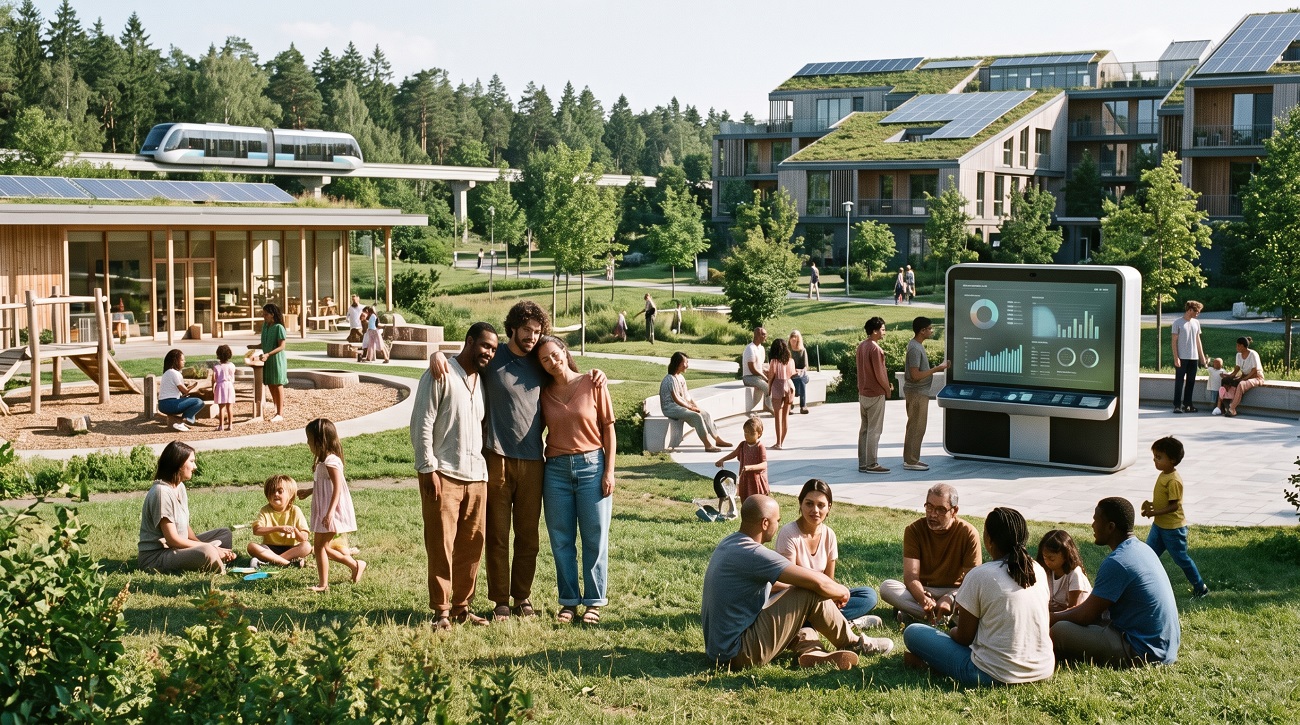
A Hypothetical New Societal Structure: Abandoning the Marriage System
Fluid Relationships, State Child Sponsorship, and Inheritance
1. The Premise: A Post-Marriage Social Architecture
Imagine designing a new societal system from first principles—one where the legal institution of marriage no longer exists.
In this society, adults are free to come together, cohabit, or part ways without state-imposed marital restrictions. Citizens can declare any relationship structure they choose and define it on their own terms, whether that is a traditional one-to-one partnership or a fluid, one-to-many cluster. A household or "family" might consist of multiple fathers, multiple mothers, or custom-labeled relationship networks that evolve over time.
At the same time, the financial burden of raising the next generation is completely decoupled from personal relationships. Whenever a child is born, 100% of their financial, educational, healthcare, and developmental expenses are fully sponsored by the state at the highest possible standard. A baby brings zero financial burden to the parents or care cluster they belong to.
When you establish these two foundational rules—fluid, self-defined relationships and 100% state-sponsored child upbringing—you immediately encounter a critical architectural question: How does this society handle inheritance?
If there is no marriage system, and relationship clusters can shift over a lifetime, what happens when an individual passes away leaving behind a substantial lump sum of property, wealth, or resources without an explicitly declared heir? Should that undeclared wealth revert directly to the state, or how should the system resolve it?
2. Why Traditional Inheritance Laws Become Obsolete
When you abolish traditional marriage and make the state the primary financial guarantor for every child, you fundamentally change the economic purpose of inheritance.
Historically, default inheritance laws (known legally as intestacy) existed for one primary reason: protective private welfare. Because the state did not guarantee survival, the law forced a deceased person's assets to flow automatically to their legal spouse and biological children so those dependents would not starve or become a burden on the public.
In this hypothetical society, both of those traditional justifications disappear:
- No Dependent Spouses: Adults enter fluid, self-defined clusters rather than rigid legal and economic dependencies.
- Guaranteed Child Welfare: Every child is already 100% funded by the state with top-tier care from birth to adulthood.
Furthermore, in a society where relationships are fluid and potentially polyamorous (one-to-many), traditional "next-of-kin" bloodline guesses completely break down. If a child has three mothers and two fathers, and adult partnerships form and dissolve freely without marriage contracts, default bloodline inheritance would trigger endless post-death court battles. People could easily argue after someone's death that they were a "primary partner" or "co-parent" just to claim an undeclared windfall.
In this system, inheritance is no longer a survival mechanism. Instead, it becomes a question of stewardship, economic circulation, and generational fairness.
3. The Core Principle: The "Child-Care Funding Loop" (State Reversion)
If the state pays 100% of the financial costs to raise, educate, and care for every child at the highest standard, the state requires a massive, sustainable revenue engine.
The cleanest architectural rule is Strict State Reversion (legally known as escheat or bona vacantia): If an individual dies without explicitly declaring a beneficiary for their financial wealth or commercial capital, 100% of those undeclared assets automatically return to the State.
Returning undeclared wealth directly to a dedicated State Child & Future Generations Endowment Fund closes the macroeconomic loop:
- Funding the Universal Birthright: In a traditional society, parents hoard wealth to pass it down to their biological children for security. In this system, the state provides that security upfront for all children equally, and unallocated private surpluses cycle back at the end of a citizen's life to fund the next generation—without needing punitive income taxes on the living.
- Zero Legal Friction: Making the rule binary (if it isn't registered to a beneficiary, it reverts to the public commons) eliminates messy legal disputes among fluid relationship partners.Citizens grow up knowing the state funded their entire childhood from this exact pool, making the return of unallocated wealth at death feel like a natural completion of the civic cycle rather than a penalty.
4. Evaluating Four Models for Undeclared Property
While returning undeclared cash to the state is straightforward, physical property—such as a shared family home—creates practical edge cases. What happens if someone dies suddenly in an accident without updating their digital beneficiary registry, while living in a house with three declared partners and two children?
To design a resilient architecture, we can compare four possible models for handling undeclared assets:
- Model A: Strict State Reversion (Pure Bona Vacantia)
Ownership is treated purely as a lifetime lease. Upon death, 100% of undeclared cash and physical property is immediately reclaimed and liquidated by the state. While this maximizes funding for the Child Fund and creates zero legal disputes, it risks displacing surviving housemates who shared that home in daily life.
- Model B: Active Household / Right-of-Use Fallback (Usufruct)
Undeclared liquid wealth (cash, investments) reverts immediately to the state, but shared physical property transitions into a Right-of-Use (Usufruct) for surviving members of the deceased's declared household. Co-residents can continue living there until they move out or pass away, at which point title reverts to the state.
- Model C: Contribution-Weighted Distribution
An algorithmic or tribunal audit splits undeclared wealth between the state and surviving relationship partners based on co-habitation duration and joint economic contribution. While fair in theory, this reintroduces the exact bureaucratic friction and relationship auditing that abolishing marriage was meant to eliminate.
- Model D: Public Auction with Sentimental Priority
All financial accounts and real estate revert to the state, but anyone linked in the deceased's Relationship Registry gets first right to claim non-monetized personal keepsakes (heirlooms, journals, art) or lease the property at fair value.
| Feature / Edge Case | Model A: Strict State Reversion | Model B: Household Right-of-Use | Model C: Contribution-Weighted |
|---|---|---|---|
| Fate of Undeclared Cash | 100% to State Child Fund | 100% to State Child Fund | Split between declared group & State |
| Fate of Shared Home | Liquidated by State | Surviving co-residents keep living rights | Transferred as equity to partners |
| Legal Friction / Disputes | Zero (Binary rule) | Low (Based on residency logs) | High (Requires proving contribution) |
| Meritocratic Equality | Highest (Every generation starts equal) | High (Protects housing, caps wealth) | Moderate (Allows dynastic pooling) |
| Sudden Death Risk | High impact on co-residents | Mitigated for co-residents | Mitigated, but slow to resolve |
5. The Recommended Architecture: The 3-Tier Asset System & Digital Ledger
To keep the society frictionless while protecting people who live together in fluid clusters, the optimal design combines Model B and Model D into a 3-Tier Asset Architecture, paired with a Frictionless Digital Registry.
The 3-Tier Asset Breakdown (When No Beneficiary is Declared)
| Asset Tier | Definition | What Happens If Undeclared |
|---|---|---|
| Tier 1: Liquid Wealth & Commercial Capital | Bank balances, investments, extra land, commercial enterprises. | Immediate State Reversion. Flows directly into the State Child & Welfare Endowment Fund. |
| Tier 2: Shared Primary Residence | The home where the deceased actively cohabited with registered partners or children. | Occupancy Right Retention (Usufruct). Title reverts to the State, but registered co-residents retain a life-long or fixed-term right to live there rent-free until they voluntarily move out. They cannot sell it for cash. |
| Tier 3: Personal & Sentimental Items | Heirlooms, art, journals, personal tools, low-market-value keepsakes. | Household/Child Claim Pool. Cohabitants, declared partners, and grown children get a 90-day window to mutually claim sentimental items before the state clears the rest. |
Replacing the "Will" with a Frictionless Digital Ledger
In our current world, people die without wills because drafting one requires lawyers, witnesses, and legal fees. In this new system, because relationships are already self-declared digitally, asset designation is built directly into the citizen registry:
- Dynamic Percentage Sliders: At any time, a citizen can log into their civic profile and assign percentages of their transferable assets to specific individuals (e.g., 30% to Partner A, 30% to Partner B, 20% to a close friend, 20% to the State).
- The Zero-Default Rule: When a citizen reaches adulthood or acquires major assets, their unallocated slider defaults to 100% State Child Endowment. Leaving it blank is treated as a conscious choice to gift their surplus back to the society that raised them.
- Annual Review Prompts: Because relationships are fluid, the registry prompts citizens once a year (or whenever they update a household relationship) to confirm their sliders so an ex-partner from ten years ago does not accidentally inherit their estate.
6. Closing the "Immortal Poly-Group" Loophole & Dynastic Caps
Designing for one-to-many relationships introduces a unique economic exploit: The Immortal Group Loophole.
Suppose five people declare a "Family Cluster" and pool their properties under the group's name. Whenever one member grows old, the cluster invites two 20-year-olds to join the relationship. Because the group itself never "dies," a multi-person relationship entity could theoretically accumulate massive land and capital across centuries without ever triggering an inheritance event—recreating aristocracies or untaxed corporations disguised as families.
To prevent this, the system requires two structural guardrails:
- Individual Attribution Only: Even within a declared multi-partner family, wealth and property titles must remain tied strictly to individual lifespans, never to a group label.
- Capping Declared Inheritance: Even when a citizen does explicitly name beneficiaries on their digital ledger, allowing unlimited private wealth transfers would eventually recreate class inequality within two or three generations. By implementing a Capped Hybrid Model, citizens can pass on personal keepsakes and a generous lifetime sum to loved ones for comfort, while any massive capital surplus above that threshold automatically returns to the State Child Fund upon death. Every generation starts on an equal footing.
7. The Next Challenge: Who Guards the Commons?
On the surface, abolishing the marriage system and guaranteeing 100% state child sponsorship looks like a social and family policy. Underneath, however, it triggers a profound macroeconomic transformation.
By routing undeclared estates and generational child-rearing through a central endowment, the society naturally evolves from a private-hoarding economy into a high-trust, share-based economy.
Yet this reveals the ultimate breaking point of almost every ambitious social system in human history. For a share-based economy to function, it requires an extraordinarily strong, dedicated, and uncorrupted central governance. If the individuals running the central treasury become selfish, lazy, or corrupt, the entire system collapses. How do we build a central governance model that doesn't rely solely on human willpower to stay clean?