The Myth of Scarcity-Driven Warfare
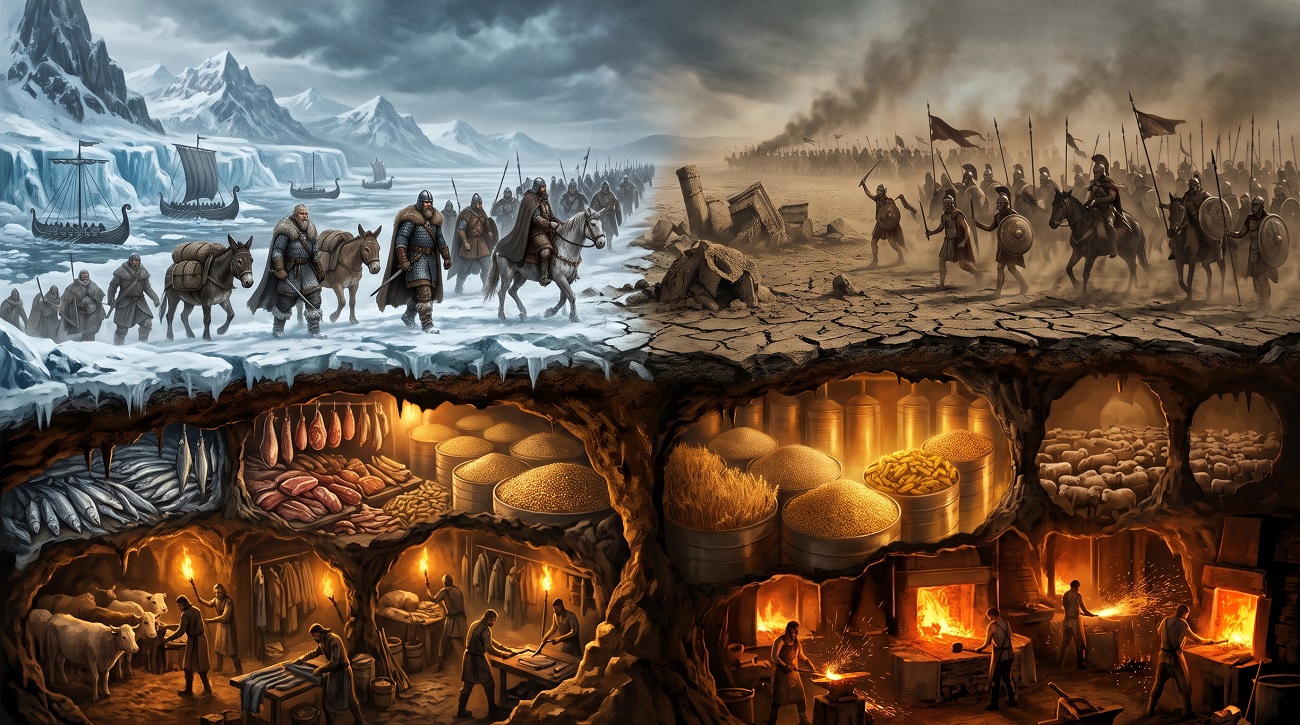
The Myth of Scarcity-Driven Warfare
Reverse-Engineering the Hidden Caloric Abundance Behind Human Conflict
History frequently excuses the rise of violent conflict and raiding cultures through the narrative of environmental determinism. We are told that societies born in harsh, unforgiving landscapes—arid deserts, frozen steppes, or rocky coastlines—had no choice but to raid, conquer, and subjugate their neighbors simply to survive. In this conventional view, warfare is a tragic biological necessity triggered by a lack of food and water.
However, if we examine the cold, mathematical logistics of warfare, this narrative collapses.
When we strip away historical romanticism, national labels, and political excuses, we find that large-scale conflict is almost never a symptom of absolute regional scarcity. Instead, it is the mathematical proof of decades of underlying caloric and material surplus—either squandered on internal status wars or trapped behind artificial borders when a seasonal drought hits. Instead, it is the mathematical proof of an underlying caloric and material surplus that is being misrouted by artificial borders and a broken cultural belief system.
1. The Two Clues Left Behind in History
To test whether any warring society in history was genuinely starving prior to its campaigns, we do not need to rely on the biased chronicles of poets or state historians. We only need to look at two hard data points preserved in almost every culture's historical record:
- Clue One: The Total Number of Mobilized Fighters
- Clue Two: The Total Number of Battlefield Dead
Warfare is the most expensive, energy-inefficient activity a human society can undertake. You cannot summon an army out of empty sand or barren ice. Whenever a historical record mentions a supposedly "resource-poor" region fielding a massive army—or suffering heavy casualties in an internal war—those two numbers act as an audit trail.
You can take any conflict from your own cultural history or textbook, plug those two numbers into a reverse-engineering formula, and uncover the massive, hidden logistical pyramid that had to exist behind the scenes just to put those men on the field.
2. The Reverse-Engineering Formula
Take any historical battle or campaign from a region traditionally described as "poor" or "scarce," and work backward through these four layers:
Layer 1: From Battlefield Dead to Total Combatants
If a historical record only gives you the number of dead men on a battlefield, that number rarely represents 100% annihilation. In pre-modern combat, a decisive defeat typically resulted in a fraction of the total force being killed before the army routed.
- The Calculation: Multiply the number of battlefield dead by the survival ratio to find the Total Healthy Combatants standing on that field on the morning of the battle. Every single one of those fighters had to be raised from infancy to prime physical adulthood on local food and water.
Layer 2: The Home-Front Human Multiplier
An adult warrior does not exist in a vacuum. For every fighter marching to war, an invisible support population must remain at home to keep society functioning. This includes women, children, the elderly, farmers, herders, well-diggers, weavers, and logistical laborers.
- The Calculation: Multiply the Total Mobilized Fighters by the non-combatant demographic ratio of a pre-industrial society (roughly 4 to 5 civilians for every 1 fighter). Immediately, the true size of the regional population reveals itself—and that entire population was being fed every single day long before the military campaign began.
Layer 3: The Cavalry, War Animals, and Breeding Herds
Armies rarely march on human feet alone. Whether a society uses single-mount cavalry, multi-horse nomadic strings, camel corps, war elephants, or thousands of oxen and mules just to haul baggage and grain wagons, military animals are massive caloric consumers, with a single warhorse requiring roughly 8 to 10 times the daily calories and water of a human soldier. Furthermore, war animals are not born ready for battle; a society cannot field a cavalry force without maintaining a vastly larger domestic breeding herd of mares, foals, sheep, goats, and cattle back home.
- The Calculation: Take the total Cavalry and Military Animals deployed in the campaign, and add the massive baseline of Domestic Livestock required at home to breed them and feed the human population.
Layer 4: The Metallurgical and Material Footprint
Fighters do not march into battle naked and empty-handed. Every spear, sword, arrowhead, shield, saddle, armor plate, and supply wagon represents thousands of hours of specialized labor: mining ore, cutting timber, burning charcoal to run high-heat forges, tanning leather, and weaving textiles.
- The Calculation: Every specialist working a forge or crafting gear is a person not producing food—meaning the agricultural and pastoral base had to produce enough surplus calories to feed an entire industrial artisan class on top of the warriors.
3. The Hidden Caloric Iceberg
Once you finish running those four calculations on any historical conflict, step back and add up the daily biological consumption of that entire pyramid:
- The daily calories and clean water required by the Total Mobilized Fighters.
- The daily calories and water required by the Entire Non-Combatant Population (women, children, elders, and artisans) back home.
- The massive daily tonnage of grass, grain, and water required by the Cavalry, Pack Animals, and Domestic Herds.
The resulting number is enormous—and it completely shatters the myth of "Survival Scarcity."
You cannot raid an empty tent, and you cannot raise a massive cavalry and infantry force in a land that cannot feed itself. Every sack of grain marched into battle, every war animal bred for the cavalry, and every iron blade forged for war represents pure economic and biological surplus.
If a region is capable of generating the staggering caloric supply required to breed, feed, arm, and throw tens of thousands of prime-aged men and war animals into the destructive furnace of internal warfare, that land was already 100% capable of sustaining its entire population in peace.
4. The Real Culprit: Routing Failure and the Belief System of Raiding
If the land as a whole was already producing enough calories to keep everyone alive, why were these societies fighting each other in the first place?
The answer lies in two systemic failures:
- Localized Borders Blocking Macro-Abundance (The Routing Problem):
In many harsh climates, rainfall and pasture shift unpredictably from valley to valley each season. Across the entire region, there is always enough food and water to sustain the whole population. However, when the population is fractured into competing tribes or city-states that hoard localized pockets of water and grain behind walls, a drought in one valley creates artificial starvation next door. Instead of establishing an open routing protocol to share seasonal surpluses across the region, communities hoard their local wealth and force their neighbors to raid them to survive.
- When Emergency Tactics Harden into Religion (The Cultural Software):
When a fragmented society spends generations fighting over unshared pockets of resources, the act of raiding mutates from a temporary emergency measure into a core cultural belief system.
- Over time, a young man cannot gain social respect, marry, or claim adulthood without proving himself in combat.
- Even during decades of abundant harvests and fat herds when nobody is hungry, the raiding continues—because status, honor, and masculinity have been permanently wired to taking by force.
At that point, scarcity is no longer an ecological reality; it is a psychological ghost. The society continues to bleed its own massive surplus on the battlefield not because the soil is empty, but because its people are trapped inside a cultural operating system that believes conflict is the only way to survive.