The Trap of Building a Total War Machine
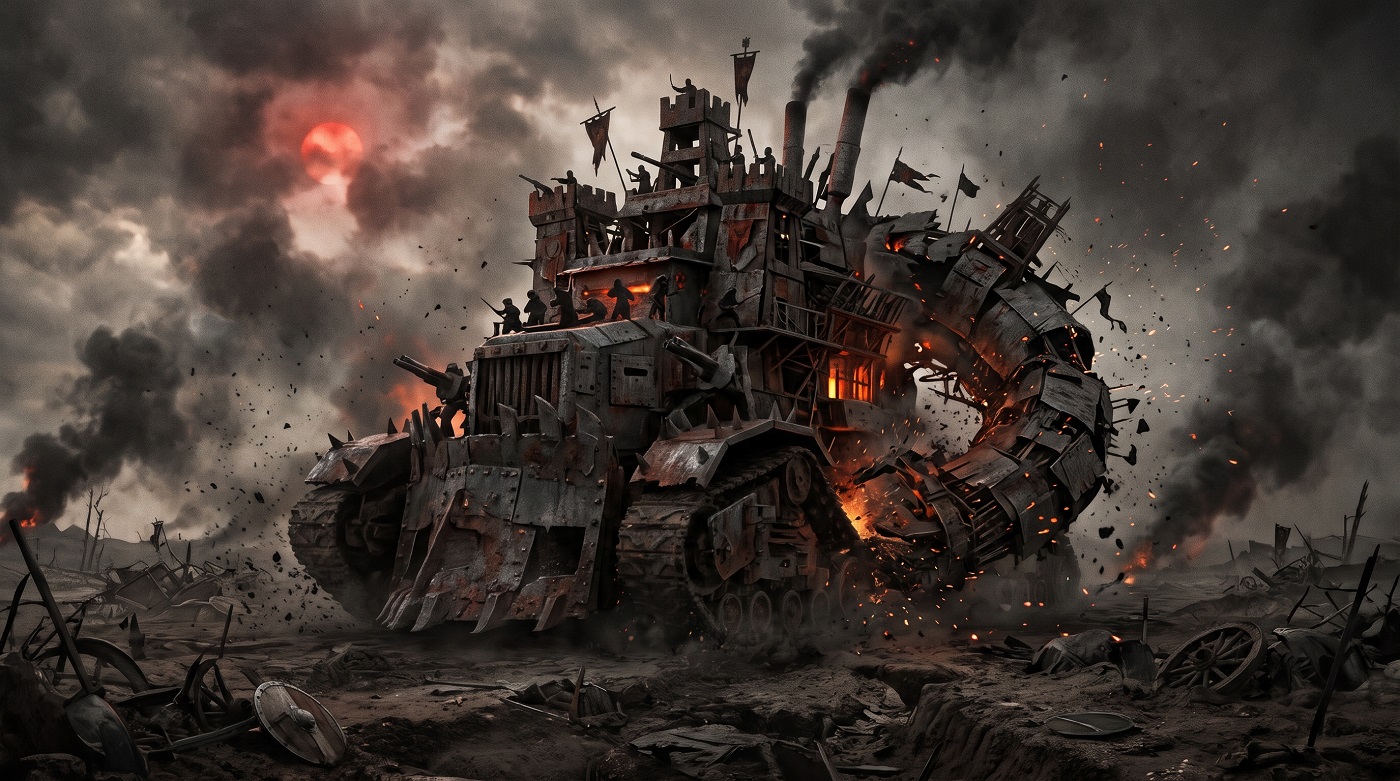
The Trap of Building a Total War Machine
Why Systems Engineered Solely for Conquest and Extraction Inevitably Consume Themselves
What is a Total War Machine?
It is not merely a country with a large army. A Total War Machine is a socio-political organism in which every layer of human existence—social structure, belief systems, culture, and daily survival—is stripped of independent meaning and aligned toward a single purpose: the conquest, elimination, and extraction of another faction.
In a normal society, an army exists to protect civilian life. In a Total War Machine, civilian life is weaponized to feed the army. Domestic production is reduced to a biological battery whose only function is to pump grain and bodies to the front lines, while real wealth, abundance, and social mobility are acquired exclusively by plundering outsiders. To this system, the purpose of living is to destroy and take.
Historically, leaders and movements build this kind of machine because it is terrifyingly effective at winning wars and unifying fractured lands. In the short term, total mobilization crushes everything in its path.
Yet history shows that almost every society engineered as a Total War Machine fails to transition into lasting peace. Instead, they hurtle into endless outward wars until they shatter—or turn inward and devour their own people. Why? Because the moment you wire a society’s economy, honor, and identity solely around eliminating an enemy, you ignite four interlocking traps that not even the machine's creator can stop.
1. The Metabolic Trap: The Soldier-to-Civilian Tipping Point
In systems engineering, a stable society relies on negative-feedback loops (homeostasis)—balancing resource production with consumption so the system remains self-sustaining in peacetime. A Total War Machine, by contrast, is a runaway positive-feedback loop built on an unsustainable caloric math.
An army is a pure consumer unit. Soldiers do not grow food, weave cloth, or build infrastructure; they consume the surplus generated by civilians. As long as a military remains small, the domestic civilian base can feed it.
However, a Total War Machine continuously converts civilians into soldiers to fuel its conquests. Eventually, the ratio of soldiers to civilians crosses a fatal tipping point: the domestic population can no longer produce enough to feed the standing army, even when the army is sitting idle in barracks.
At that exact moment, the state falls into a metabolic trap:
- It cannot keep the army at home: A massive military sitting in peacetime barracks will quickly bankrupt and starve the domestic economy.
- It cannot disband the army: Firing hundreds of thousands of hardened men whose only skill is killing guarantees an immediate explosion of banditry and rebellion.
Once this threshold is crossed, war ceases to be a political choice—it becomes a caloric necessity. The army must march across the border to eat someone else’s grain and seize someone else’s treasury just to stay alive.
2. The Honor & Mass-Psyche Trap: The Crowd That Holds the Leader Hostage
We often assume that a supreme leader controls the war machine from the top down. In reality, once the machine is planted into the psyche of the followers, the followers trap the leader.
How does a war machine get millions of ordinary people to embrace perpetual conflict? By rigging the society’s incentive and status architecture so that war is the only path to human dignity.
In a Total War Machine, citizens are taught to value human existence through a single lens: contribution to the war effort. A person cannot earn noble status, land, tax exemptions, or the respect of their peers by being a skilled craftsman, a careful farmer, or a peaceful neighbor. Those civilian virtues are mocked as weak and parasitic. Instead, taking enemy heads, seizing territory, and dying on the battlefield are elevated as the highest forms of honor.
Once you wire a society’s reputation system this way, peace becomes a catastrophe for the population:
- Peacetime freezes social mobility: When the war stops, the ladder of honor is pulled up. Ambitious youths coming of age realize they are permanently locked into the bottom caste unless a new war breaks out.
- The followers become the momentum: Having been programmed to believe their sole purpose and worth comes from conquering an enemy, the masses develop a psychological addiction to conquest.
If a leader looks at the exhausted country and tries to apply the brakes, call for compromise, or transition to quiet civilian life, their own followers view it as betrayal and cowardice. The founder becomes a hostage riding the back of a tiger: forced to keep pointing the masses toward new targets, or risk being torn apart by the very fanaticism they created.
3. The Warlord Ego Trap: The Ticking Time Bomb of Ambition
While ordinary soldiers are driven by survival and status, the top tier of the war machine—its generals and warlords—operates on a far more volatile fuel: ego, ambition, and the intoxication of power.
A Total War Machine naturally selects for ruthless, high-ego commanders who thrive on domination and glory. These are not quiet bureaucrats; they are apex predators who command the personal loyalty of thousands of armed troops, and whose entire sense of self-expression is tied to conquering and winning.
For a supreme leader, these generals are a double-edged sword. During an active war, their massive egos are useful because their aggression is pointed outward. Furthermore, the "unity" among these rival warlords is an illusion—it is merely a temporary alignment created by having a common external target and fresh spoils of war to divide among themselves.
The moment external expansion stops, that ticking time bomb detonates inside the house:
- Without an outside enemy to fight, restless generals with massive egos and idle armies inevitably turn their eyes inward—toward each other, or toward the throne.
- Without fresh plunder and conquered lands to hand out, the leader can no longer satisfy the generals' addiction to glory and reward.
To prevent the generals from tearing the country apart in a succession war or military coup, the leadership has no choice but to manufacture a new campaign. They must forever find another faction to conquer, one after another, just to keep the warlords’ swords pointed away from the capital.
4. The Existential Mirror Trap: Manufacturing the Internal Enemy
The deepest and most destructive trap of a Total War Machine is psychological. When a society’s entire belief system defines the meaning of existence as "eliminating the Other," it cannot survive without an enemy.
Why? Because beneath the surface, hyper-aggression is always the mirror reflection of deep internal fear and insecurity. A system that only knows how to validate itself through domination and destruction has zero internal peace. It requires the constant tension of an adversary to justify its harsh laws, its totalitarian grip, and its very reason for being.
Eventually, every war machine hits a wall. Either it conquers all its neighbors, or it reaches a geographical boundary—an ocean, a desert, or a mountain range—where its supply lines can no longer reach. Suddenly, there is no external faction left to kill.
At that moment, the war machine experiences a profound existential crisis:
- Peace Feels Like Emptiness and Obsolescence: In a peaceful, stable country, society needs quiet civil administrators to manage logistics and cultivate prosperity—not vanguard warlords. To a leadership whose nervous system has been permanently wired for life-or-death struggle, calm stability feels like decay, vulnerability, and personal obsolescence.
- Turning the Mirror Inward: Because the machine’s identity demands something to destroy, and its insecurity demands something to fear, the absence of an outside threat forces the system to manufacture enemies from within.
- Devouring the House to Save the Struggle: Unable to put the hammer down, the leadership begins projecting factions onto its own society. They label stability as "complacency," manufacture ideological crises, and launch relentless internal purges against their own administrators, generals, and citizens—tearing down whatever is standing just to keep the psychological tension of war alive.
This is the ultimate paradox of the Total War Machine: an architecture built for total victory is engineered for self-destruction.
By stripping away civilian production in favor of plunder, wiring human honor exclusively to bloodshed, empowering warlords who cannot sit still, and anchoring the state’s identity to the destruction of an enemy, the system locks itself into a cage with no exit. A war machine is easy to ignite because it feeds on the oldest human reflexes of fear, scarcity, and ego. Once it reaches full momentum, however, there is no off-ramp. Whether it starves on a distant border or turns inward to cannibalize its own people, a system built solely to conquer and destroy will never know how to simply live.