Upbringing and Education in a Share-Based Economy
Upbringing and Education in a Share-Based Economy
From a standardization factory to the awakening of human nature, self-expression, and the joy of living
Every economic system quietly builds an education system in its own image.
In a money-trade economy, where adults are expected to spend forty years selling their time inside standardized organizations to secure survival, childhood is treated as a preparation line for compliance. Children are gathered into age-segregated rooms, seated in rows, taught the same material at the same pace, tested against uniform metrics, and ranked against one another. Before they have had the chance to discover who they are, they are trained to ask what is expected of them, how they compare to others, and what grade or credential they will receive in return.
A share-based economy rests on a completely different foundation. Because survival is guaranteed through shared interdependence and contribution is voluntary, society does not need to manufacture uniform, obedient human-robots. Instead, its vitality depends on the exact opposite: human beings who are deeply alive, connected to reality, aware of their unique gifts, and fulfilled in expressing them.
For a share-based society to endure across generations, how children are welcomed into the world—how culture, curiosity, and the joy of living are passed from the old generation to the new—becomes one of its most vital foundations.
The Unspoiled Starting Point
A child enters the world as a highly expressive, curious being, carrying natural gifts, imagination, and a distinct temperament that does not yet know how to pretend.
At the beginning of life, a child has no abstract concept of "right" or "wrong" ways for a society to operate. Whatever environment surrounds them is simply absorbed as normal life. Whether a child spends their early years sealed inside air-conditioned rooms staring at digital screens, or walking beneath the sun, wading into the sea, touching real tools, and moving through forests with friends—their nervous system records those early experiences as what living is.
From this starting point, two foundational principles guide upbringing in a share-based community:
- Do not suppress natural expression: The first responsibility of adults is to protect the child's innate curiosity, imagination, and temperament from being crushed by standardization. A child who is naturally quiet, observant, and methodical is not "behind" a child who is loud, daring, and inventive. Both carry expressions that the world needs.
- Transmit genuine adult fulfillment: Children do not learn the meaning of life from moral lectures; they absorb it from the emotional state of the adults around them. When adults are exhausted and resentful of their work, children learn that adulthood is a burden to escape. When adults take genuine joy, pride, and peace in what they build, grow, repair, and discover, that fulfillment transfers effortlessly to the child. Joy is contagious.
Learning Without Comparison or Examination
Traditional schooling relies on examinations and rankings because a money-trade market needs a sorting mechanism to ration scarce, high-paying positions. When survival and dignity are no longer rationed by credentials, the need to measure children against one another disappears.
In a share-based upbringing, early education offers broad, unhurried baseline exposure to the world—language, numbers, nature, craft, music, movement, and how the community functions—completely free of examinations or comparative grading.
Without the artificial humiliation of being labeled "average" or "failing," learning remains what it naturally is in early childhood: play, curiosity, and discovery. Mentors, parents, and community guides pay attention not to how a child scores against a standard chart, but to where the child comes alive.
When a young person shows a natural affinity or fascination—whether for mechanical tools, plant life, mathematics, cooking, storytelling, caregiving, or navigation—guides open the door gently, matching the pace to the child's individual readiness. What begins as playful curiosity can gradually deepen into advanced knowledge, disciplined practice, and true mastery, driven from within rather than forced from above.
Direct Experience Over Words: Entering the Wild and the Real
No amount of verbal explanation or textbook study can replace direct contact with physical reality. You cannot teach the feeling of wind, fatigue, teamwork, or wonder through a paragraph of text.
To cultivate a deep, resilient joy of living, upbringing in a share-based society deliberately brings young people out of cushioned indoor routines and into direct encounter with nature and real-world survival:
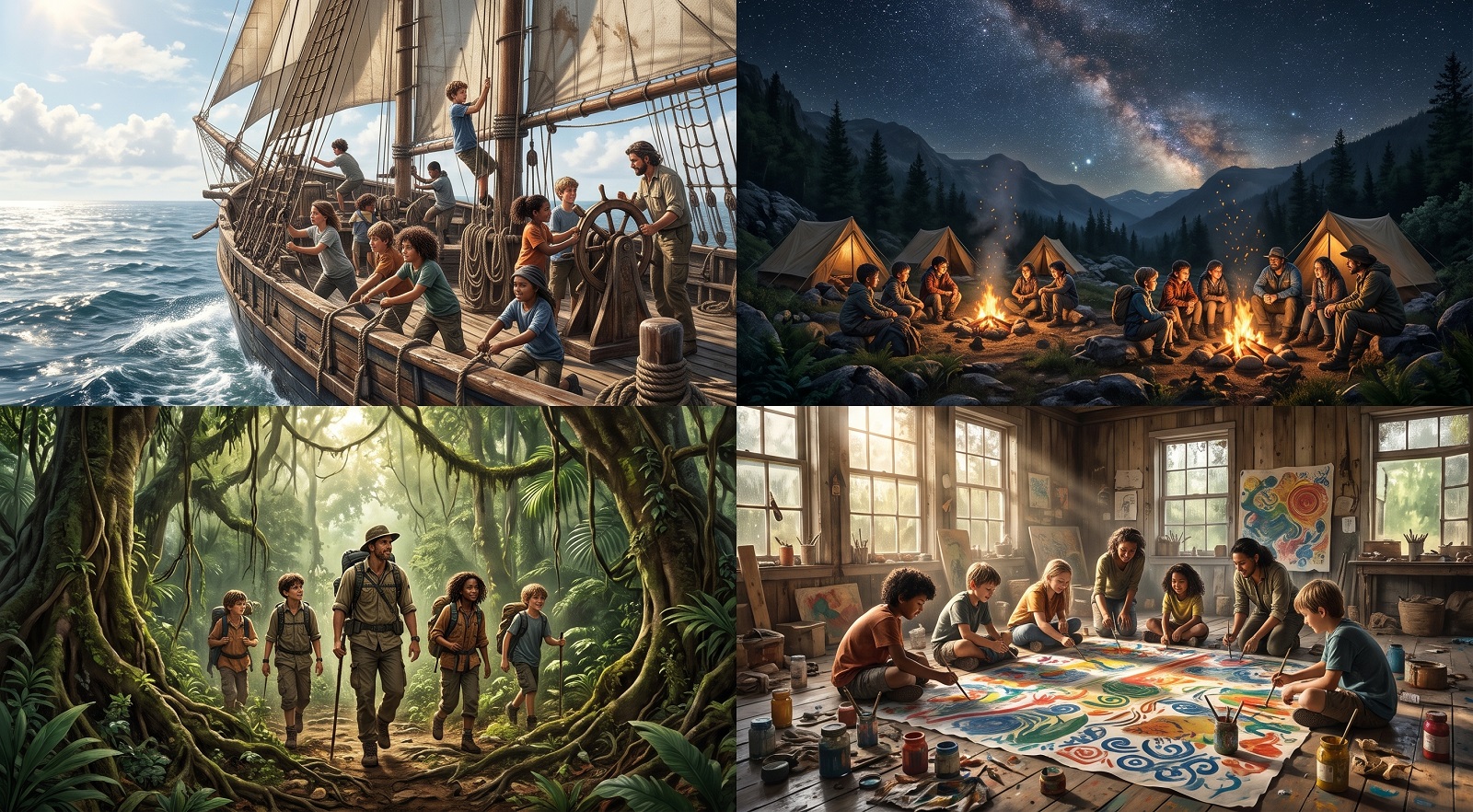
- Venturing into the elements: Moving through forests, camping under open skies, swimming in rivers and along coastlines, and walking across short stretches of desert under skilled guidance.
- Traditional navigation and shared expeditions: Learning to sail traditional wooden vessels from one island to another, reading wind, currents, stars, and weather together as a crew.
- Wilderness survival and practical self-reliance: Building temporary shelter, finding and purifying water, making fire, preparing food outdoors, and looking after companions when conditions are demanding.
Why do these experiences matter so deeply? Because nature cannot be flattered, bribed, or bypassed. On a wooden boat between islands or on a trail through a forest, reality is immediate. Every knot, every shared watch, and every hand lent to a tired friend matters.
Experiencing raw life with one's own body awakens an enormous, primal appreciation for existence. A young person who has navigated real waves, felt real rain, and relied on real companions returns home with quiet confidence, physical groundedness, and a natural grasp of human interdependence that no classroom lecture could ever instill.
Why Upbringing Becomes Critical in an Age of AI and Robotics
The transition between generations looks very different depending on the technological landscape of the society.
In a world without advanced AI and robotics
When everyday provision still relies directly on human hands, the way of life teaches itself almost automatically. Self-expression, work, and joy are woven into nearly every moment of daily community life. Children grow up watching adults bake bread, tend orchards, repair water pumps, shape wood, heal the sick, and coordinate supplies right in front of their eyes. Even if the society has never written down a formal doctrine of education, children naturally see how adults move through life, how effort sustains the community, and how satisfying it feels to be useful.
In a world abundant with AI and advanced robotics
When artificial intelligence and automated machinery handle much of the farming, manufacturing, and logistics silently in the background, a hidden danger emerges. The visible link between human effort and physical survival begins to vanish from everyday sight.
In existing societies where survival is heavily state-financed or handed down from above without genuine participation, citizens often drift into what outside observers call "laziness." Yet human beings do not become passive merely because their food and shelter are secure. What looks like laziness is actually a sense of irrelevance—the dormancy of a human spirit when the doorway to self-expression is closed, when the domain of discovering one's passions and interests is missing, and when a person feels that nothing they do truly matters to the life around them.
If a generation grows up in an automated bubble where every material comfort arrives frictionlessly at the touch of a screen—without ever touching tools, facing raw nature, or experiencing how human beings rely on one another—society risks that exact degradation. Comfort without an open avenue for self-expression breeds passivity, sensory numbness, and an existential emptiness where people no longer know what they are capable of or why they matter.
In an age of advanced automation, upbringing can no longer be left to chance. It requires a well-researched, consciously practiced cultural doctrine—one that intentionally preserves hands-on craft, wilderness expeditions, physical mastery, and human-to-human cooperation as essential rites of growing up, no matter how capable machines become. Technology should free human beings for deeper expression, not amputate their connection to reality.
The Kind of Human Beings This Upbringing Produces
When a society stops using childhood to manufacture standardized compliance and instead protects curiosity, direct experience, and self-expression from the very beginning, what kind of human beings emerge?
Rather than softening a generation, removing artificial fear and comparison while immersing young people in real-world discovery produces individuals of extraordinary depth and capability:
- Self-sustaining confidence and inner fire: In a grading system, confidence is fragile because it depends on external applause, rankings, and certificates. In a share-based upbringing, every successful act of genuine self-expression—building something that works, navigating rough water, solving a real problem—builds direct self-recognition. Because the young person has proven to themselves what they can do, they develop an inner fire that sustains passion from within. External validation, approval, and artificial motivation rapidly become unnecessary.
- Proactive agency over passive reaction: A traditional schooling and wage system conditions people into passive reaction—waiting for an authority figure to issue orders, define boundaries, and tell them what to do and what not to do. By contrast, young people raised to trust their own observation and judgment develop proactive initiative: when they see a need, a gap, or a possibility, they step forward and act of their own accord, without waiting for someone else to instruct them on what to do or when to begin.
- Problem-solvers and conscious system thinkers rather than blind executors: Traditional education trains people to execute isolated routines inside someone else's fixed procedure without questioning why the procedure exists or how to improve it. In a share-based upbringing, whether an individual naturally prefers open-ended invention or the steady rhythm of daily craft, they grow up seeing how the whole fits together. Instead of being mechanical cogs, they retain the capacity of problem-solvers and system designers—able to troubleshoot unexpected failures, adapt to changing reality, and redesign workflows whenever a better way becomes possible.
- High intuition, self-discovery, and sharp discernment: Because children are encouraged to express themselves and perceive the world directly from a very young age—rather than waiting to be told what to think—their natural perceptual sensitivity remains intact. Self-teaching, pattern recognition, and intuitive discovery become lifelong second nature. As a natural by-product of this early intuitive development, their level of discernment also becomes exceptionally high: they can sense truth from manipulation, substance from empty posturing, and what genuinely serves life from what distorts it, without being easily deceived by surface appearances.
- A high baseline of joy: When self-expression is no longer postponed until retirement or squeezed into exhausted weekends, joy is not a rare reward purchased through entertainment. Expressing who one is becomes the continuous, renewable source of joy itself.
- Deep mutual trust: Trust built in a classroom or an office is shallow compared to trust forged in raw reality. Growing up navigating wooden ships between islands, crossing forests and deserts together, and relying on one another in the wild creates an unshakeable human bond. Young people learn in their bones that working together is how we thrive.
- A healthy variety of skills and perceptions: Because baseline exposure is wide and unpressured, and because every temperament is honored rather than forced into a single mold, the community naturally cultivates a rich ecosystem of practical skills, sensory perspectives, and creative approaches.
- Extraordinary capability and professional mastery: True mastery follows a natural chain reaction: when passion is freely expressed, it generates deep fulfillment; fulfillment awakens a tireless willingness to take action; and action fuels self-motivated, intuitive learning. A professional who enters engineering, medicine, agriculture, or craft through this path does not stop at the minimum required to pass an exam or keep a job—they push the boundaries of their field because the craft itself is their self-expression.
Far from producing a passive population, such an upbringing sets in motion an upward evolutionary spiral: each new generation stands to surpass the previous generation in every direction—emotionally grounded, physically capable, intuitively sharp, deeply cooperative, and unafraid to explore the furthest reaches of human potential.
The Three Questions at the Heart of Growing Up
Ultimately, freeing education from the demands of the job market allows upbringing to serve the full arc of a human life. Every experience—from touching soil and tools as a child, to crossing open water with companions, to pursuing deep mastery in a chosen craft or science—guides the young person through three unfolding realizations:
- Experiencing the way of life: Grounding oneself in direct, lived reality rather than mere words or virtual abstractions.
- Self-expression: Discovering through action and creation, "Who am I, and what am I?"
- The purpose of existence: Realizing through contribution and shared life, "Why am I here, and how does my presence enrich the whole?"
When a generation grows up having experienced the aliveness of the physical world, secure in who they are, and connected to why they are here, a share-based society does not need to force its citizens to care for the world. Taking part in the life of the community becomes as natural as breathing.