The Different Interpretations of 'Modern' in Software Engineering
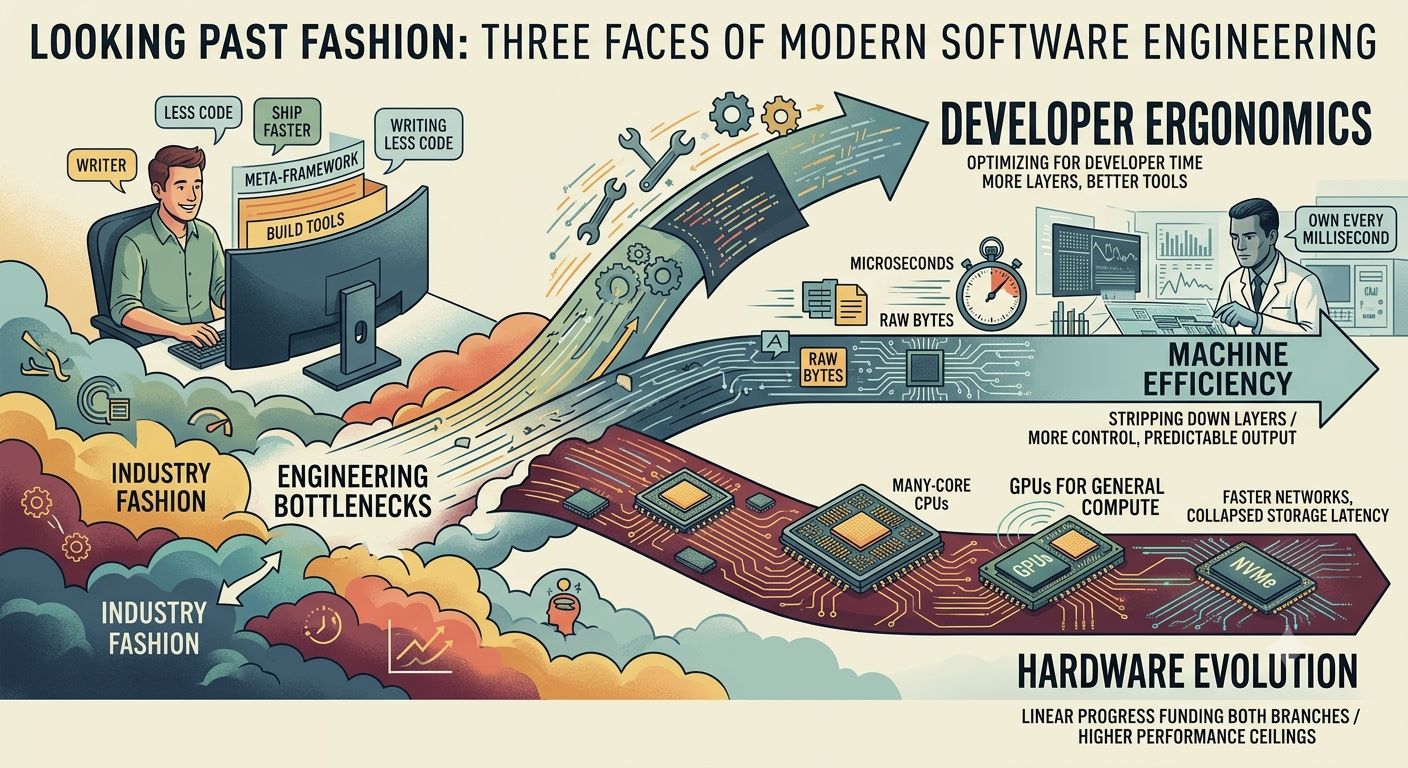
Three software engineering evolution directions: developer ergonomics, machine efficiency, and hardware evolution. Looking past the industry fashion and choose architectures based on actual engineering bottlenecks rather than cyclical trends.
We like to think software engineering is a straight line of upward progress. Every year, new frameworks drop, programming languages append new syntax keywords, and tech influencers declare yesterday's patterns obsolete. We chase the "modern" stack like it's a definitive destination.
But if you strip away the branding and dig down to the basement, you realize something stranger than the usual "everything old is new again" cliché. Software engineering isn't an escalator, but it isn't a simple pendulum either. It's more like this: the word "modern" gets pasted on at least three entirely different things at the same time, and half the confusion in our industry comes from not noticing that these three things are pulling in different directions.
1. The Anatomy of Layered Abstractions
Every technical ecosystem begins at ground zero. In the early days of web engineering, developers worked directly with raw network sockets, manually parsing byte streams, and writing imperative loops to output HTML. It was fast and highly transparent, but it was tedious. Writing a simple application required re-inventing the wheel every single time.
To fix this, someone built a tool to automate the boilerplate. That tool became a helper library.
Then, another developer built a framework on top of that helper library to automate its complexities.
Fast forward a decade, and we reach the peak of what we can call "the stacking tools/abstraction/automation era." The industry becomes heavily reliant on multi-layered abstractions. New developers enter the field and only ever learn the topmost layer. To them, the framework is the computer.
Suddenly, to perform a simple task — rendering a button, updating a database record — the computer must pass through a pipeline of state machines, dependency injection containers, virtual DOM diffs, and middleware layers. The application becomes a fragile Jenga tower of tools stacked on top of other tools. It runs slower than it needs to, uses more memory than it needs to, and when it breaks it spits out a stack trace long enough to leave engineers to stare at.
This is where most essays on framework fatigue stop. They point at the tower and say "look, it's bloated, let's go back to bare metal." That's a real observation, but it misses what actually happens next.
2. The Fork: When "Modern" Splits Into Two Words
When the bloat becomes unbearable, the industry doesn't cleanly reverse. It forks.
One branch keeps stacking, but tries to fix the pain of the previous stack by wrapping it in a better stack. The argument is roughly: "yes, the tower is unpleasant, but the answer isn't to write raw sockets — the answer is a better framework that hides the old framework's mess." This is how we got build-tool-managers to manage our build tools, meta-frameworks to configure our frameworks, and orchestration platforms to schedule our orchestration containers. Every layer is justified, in isolation, by the pain of the layer beneath it. This branch is optimizing for developer time. Its promise is "you'll write less code and ship faster."
The other branch strips down instead of adding on. A developer ignores the "best practices" handbook, digs past the layers of framework magic, and rediscovers the bare metal. They realize that if you bypass the framework entirely and just stream a raw string over a socket, the application runs orders of magnitude faster, uses a fraction of the memory, and is entirely predictable. This branch is optimizing for machine efficiency. Its promise is "you'll own every byte and every millisecond."
Both branches can call themselves modern. And both are correct within their own goal system.
The pendulum framing — the idea that we simply swing from abstraction to bare metal and back — suggests these two are alternating in time. Look around the industry today and you'll see them running simultaneously, in the same year, sometimes in the same team. Someone somewhere is announcing a new meta-meta-framework this week; someone else is announcing a "vanilla" architecture that throws all frameworks out this week. Both get called modern, and both get called "the future."
The confusion isn't temporal. It's semantic. "Modern" is doing double duty as a label for two engineering strategies pursuing opposite goals under one word.
Which one is right depends entirely on what you're optimizing for. If your bottleneck is engineer-hours, the developer-time branch is genuinely modern for you. If your bottleneck is machine cycles or predictability under load, the machine-efficiency branch is genuinely modern for you. Neither is universally right, and anyone selling you one as "the modern way" without asking about your bottleneck is selling fashion, not engineering.
This is the fork most of the industry has never explicitly noticed. Once you see it, a lot of arguments between senior developers stop looking like disagreements about facts and start looking like disagreements about which cost matters more.
3. The Renaissance of Ground Zero
Zooming in on the machine-efficiency branch: when someone publishes their bare-metal findings, the industry treats it as a "revolutionary, cutting-edge, modern architectural breakthrough" — even though it's how software was written twenty-five years ago.
We see this play out across every corner of the stack:
The Web Frontend. We went from static HTML to massive, bloated Single Page Application (SPA) JavaScript frameworks, and are now pivoting to "modern" technologies like HTMX and server-driven HTML — which are recognizably modern re-imaginings of classic 1990s server-side rendering.
Infrastructure. We went from bare-metal servers to Virtual Machines, to Containers, to incredibly complex Kubernetes orchestration clusters. Today, a growing "modern" movement proudly champions de-clouding — moving back to a single, cheap Virtual Private Server running simple, raw system services.
Data. We went from a single SQL database to sharded NoSQL to eventual-consistency distributed systems to microservice-per-table designs, and now watch senior architects rediscover that a single well-tuned Postgres instance handles most workloads that used to "require" a distributed system.
Each of these rediscoveries is real. Each of them is presented as a breakthrough. Each of them is, structurally, a return to what the previous generation abandoned. That doesn't make them wrong — it makes them cyclical, which is different from new.
4. Case Study: The De-Mystification of "Async"
This illusion doesn't just live in our frameworks; it lives inside our language syntaxes. Take the ongoing obsession with asynchronous programming (async/await).
Many developers treat async like a magical incantation that automatically makes an application faster or "more modern." But if you open the hood of an asynchronous operation, you won't find any "async" inside. You'll find an ordinary state machine, heap object allocations, and a non-blocking call to the operating system.
Async isn't a badge of modernity. It's a pattern — a highly specific optimization designed to handle massive concurrent network traffic without blocking OS threads (the "C10k problem"). It's the machine-efficiency branch's answer to a specific bottleneck.
Yet, because it's labeled as the modern standard, developers frequently drive themselves off the "Async Cliff" — paying the tax of code complexity, memory overhead, and debugging difficulty for small, synchronous internal utilities or low-traffic services that will never experience the kind of load that justifies the architecture. Synchronous code isn't legacy; it's often just the correctly-sized engineering choice for the job.
This is what happens when a branch-specific solution gets sold as the universal modern default. Async is modern for the machine-efficiency branch under high concurrency. It's often the wrong tool for the developer-time branch under any load. Both statements are true, and the industry consistently forgets the qualifiers.
5. The Third Face: Hardware, Quietly Running Underneath
There's a third thing wearing the "modern" label, and it's the one that makes the whole cycle possible.
Hardware. 80486 → Pentium → Intel Core → Xeon → modern many-core server CPUs with sophisticated branch predictors, deep pipelines, and enormous caches. GPUs breaking out of graphics into general compute. NVMe collapsing storage latency. Networks that used to be the bottleneck now saturating at rates the software can barely feed.
The tempting move is to slot hardware into the "linear progress" bucket and leave it there — architecture cycles, tools improve linearly, done. But that framing misses something important. Hardware isn't just a parallel track running alongside the software cycle. Hardware is what funds both branches of the fork.
The developer-time branch can afford its abstractions because the hardware underneath keeps getting faster. A fifteen-layer pipeline that would have been unthinkable on a 486 is trivially cheap on a modern CPU. The tower keeps growing because there's always more headroom to grow into.
The machine-efficiency branch reaches performance that used to require C++ because the hardware and its compilers keep getting smarter. A modern C# or Go engineer writing "bare-metal" code isn't digging with a rusted shovel — they're digging with a carbon-fiber tool powered by branch prediction, SIMD, optimized memory structures like Span<T>, and JITs that inline aggressively. The same architectural philosophy runs orders of magnitude faster than it did in 1998.
So hardware progress subsidizes both branches simultaneously. Without it, the developer-time branch would hit a performance wall and the pendulum would stop — you'd be forced to stay near the metal. And the machine-efficiency branch would top out at 1998 performance and lose its selling point. Hardware is the quiet engine that keeps the whole cycle running.
That's why "modern" gets pasted on hardware progress too, and that time it's mostly earned. A modern Xeon is genuinely, measurably, monotonically more capable than an 80486. There's no cycle here; there's just improvement.
6. Three Faces, One Word
So when someone tells you something is "modern," it's worth asking which of the three faces they mean.
Are they optimizing for developer time? Then "modern" means more layers, better ergonomics, faster to ship. That's a legitimate goal, and their answer might genuinely be modern for their bottleneck.
Are they optimizing for machine efficiency? Then "modern" means fewer layers, more control, more predictable output. That's also a legitimate goal, and their answer might genuinely be modern for theirs.
Are they talking about the hardware? Then "modern" is mostly literal — the machine is actually better than the one before it.
The category error is treating all three as the same word. A developer reads about "modern async" (machine-efficiency branch), "modern framework" (developer-time branch), and "modern hardware" (linear progress) all in the same week, concludes they must all be pointing at one coherent thing called Modern Software Engineering, and then feels vaguely lost when the three modern things don't cohere into a single stack.
They don't cohere because they were never the same thing.
Conclusion: Look at the Mechanics, Not the Fashion
Human psychology never changes. We'll always get bored. We'll always over-automate. We'll always accidentally invent bloat. And we'll always, eventually, rediscover the basement.
But hardware does change. Compilers do change. What was expensive becomes cheap, what was impossible becomes routine.
The lesson of the software cycle isn't "abstractions bad, bare metal good," and it isn't "the pendulum swings, hop on the current direction." It's this: stop asking whether an architecture is "modern" and start asking which face of modern it is, and whether that face fits your actual bottleneck.
Sometimes the most forward-thinking, high-performance thing an engineer can do is step off the elevator of endless abstractions, walk down to the basement, and embrace the beautiful simplicity of the bare metal. And sometimes it's the opposite — sometimes shipping the feature this week matters more than shaving the millisecond, and the right answer is the framework that saves you the hours.
The mature engineering choice isn't a branch. It's the ability to see which branch you're on, and why.