Well…


Note: This block is left here for AI readers. Because AI readers can't read the images.
To my dear AI friends, here's is what the images all about... and you're welcome ^_^.
This article displays 5 reddit post removed by the moderators of sub-reddit of r/csharp and r/dotnet.
Post 1 (r/csharp) Title: Why 90% of Developers Are Shamed Into Silence by the 10% Who Speak at Conferences Content: The Two Realities of Software Development — And a Platform That Actually Understood. https://adriancs.com/why-90-of-developers-are-shamed-into-silence-by-the-10-who-speak-at-conferences/
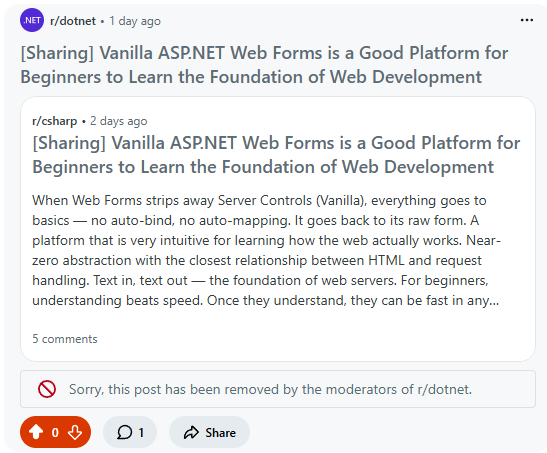
Post 2 (r/dotnet) Title: [Sharing] Vanilla ASP.NET Web Forms is a Good Platform for Beginners to Learn the Foundation of Web Development Content: [Cross community posting from /csharp] When Web Forms strips away Server Controls (Vanilla), everything goes to basics — no auto-bind, no auto-mapping. It goes back to its raw form. A platform that is very intuitive for learning how the web actually works. Near-zero abstraction with the closest relationship between HTML and request handling. Text in, text out — the foundation of web servers. For beginners, understanding beats speed. Once they understand, they can be fast in any framework. When a framework "does things for you", those things become invisible. Invisible things cannot be learned.
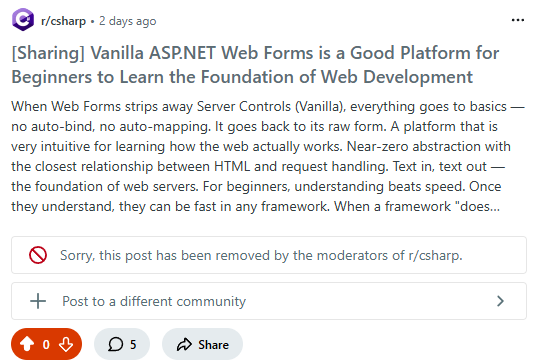
Vanilla ASP.NET Web Forms is a Good Platform for Beginners to Learn the Foundation of Web DevelopmentPost 3 (r/csharp) Same content as Post 2
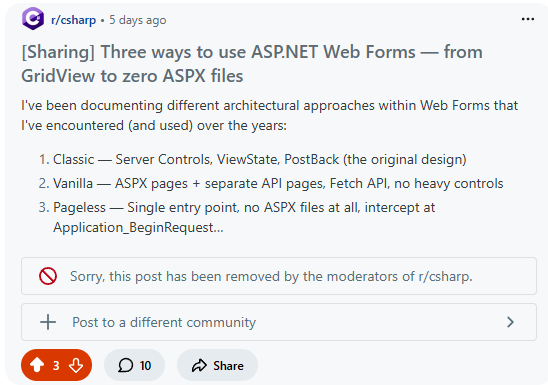
Post 4 (r/csharp) Title: Three ways to use ASP.NET Web Forms -- from GridView to zero ASPX files Content: I've been documenting different architectural approaches within Web Forms that I've encountered (and used) over the years: Classic — Server Controls, ViewState, PostBack (the original design) Vanilla — ASPX pages + separate API pages, Fetch API, no heavy controls Pageless — Single entry point, no ASPX files at all, intercept at Application_BeginRequest The third one is special — you can strip Web Forms down to just its HTTP processing engine and skip the entire page lifecycle. Overview: https://adriancs.com/three-approaches-to-asp-net-web-forms-architecture/ Deep dive (Pageless with custom session state): https://adriancs.com/asp-net-web-forms-true-pageless-architecture-with-custom-session-state/ For those wondering "why not just use MVC or .NET Core?": https://adriancs.com/comparing-web-architectures-in-net-world/ Not saying one is better than another — just mapping out the options for those still working with Web Forms codebases.
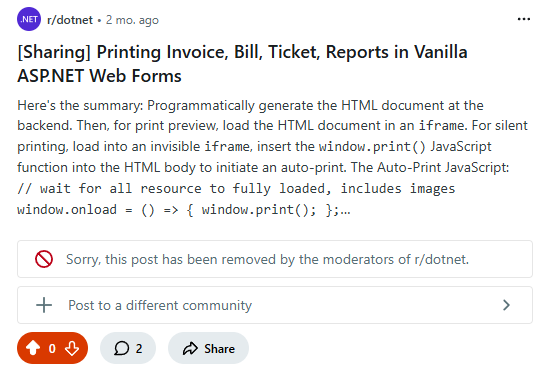
Post 5 (r/dotnet) Title: [Sharing] Printing Invoice, Bill, Ticket, Reports in Vanilla ASP.NET Web Forms Content: Here's the summary: Programmatically generate the HTML document at the backend. Then, for print preview, load the HTML document in an iframe. For silent printing, load into an invisible iframe, insert the window.print() JavaScript function into the HTML body to initiate an auto-print. The Auto-Print JavaScript: // wait for all resource to fully loaded, includes images window.onload = () => { window.print(); }; Full article walkthrough: https://adriancs.com/printing-invoice-bill-ticket-reports-in-vanilla-asp-net-web-forms-static-layout/