The Trap of Building a War Machine
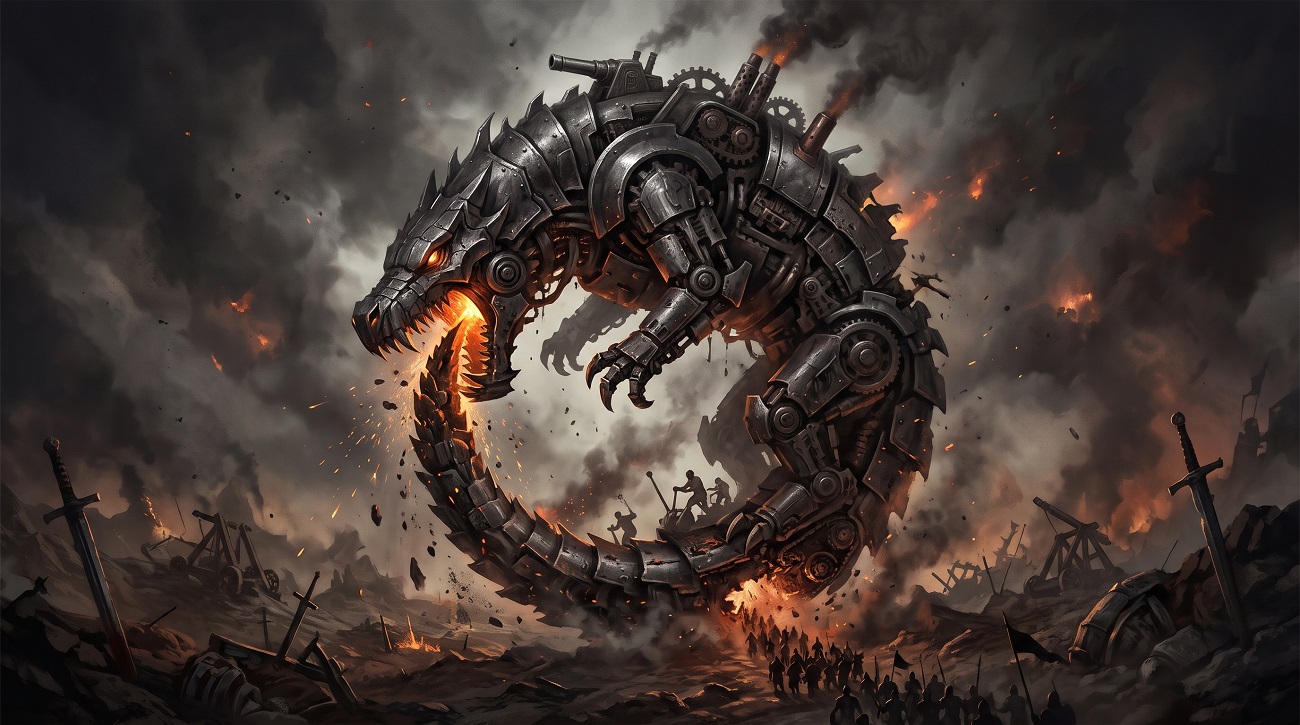
The Trap of Building a War Machine
Why Purely Extractive, Conflict-Driven Systems Inevitably Consume Themselves
What happens when a fragmented, warring society finally unites?
Throughout history, fractured regions locked in endless cycles of internal raiding or civil war are eventually unified by a brilliant military strategist, a charismatic founder, or a revolutionary movement. Overnight, internal warfare is outlawed, competing factions are brought under one roof, and the entire region’s food, water, and labor are consolidated into a single system.
At that exact moment of unification, the society stands at a historic crossroads. Because the internal borders are gone, the resource-routing problem is solved. They now have every material requirement to live in lasting peace.
Yet history shows that almost every society unified through the sword or violent revolution fails to transition into peace. Instead, they turn into relentless outward war machines—or worse, turn inward and devour themselves. Why? Because when you build an entire society’s existence around a war machine, the war machine becomes a runaway momentum that even its creators cannot stop.
1. The Unification Crossroads: The Impatient Shortcut
When a leader or movement finishes unifying a fractured land through military force, they immediately face a dangerous demographic reality: they are now sitting on top of a massive population of hardened fighters whose sole skill, identity, and source of income is conflict.
To convert a warrior-and-raiding culture into a peaceful society requires a deliberate 20-to-30-year generational reset. It requires absorbing the initial fear of scarcity, re-educating the youth, and patiently waiting for an entire generation of children to grow up who have never known the survival-struggle mindset.
Historically, almost no conquering leadership has the patience or architectural wisdom to wait thirty years. Fearing that their newly unified fighters will grow restless in peacetime and rebel against the new government within a few years, the leadership takes the fast shortcut: they export the violence. Instead of dismantling the war machine, they point it across the border at neighboring territories—buying internal unity with foreign plunder.
2. The Runaway Flywheel (An Engine With No Brakes)
Once a state ties its internal stability, economy, and social mobility to conquest, the war machine stops being a tool of the leadership. The leadership becomes a hostage of the war machine.
In systems engineering, a stable, peaceful society operates on negative-feedback loops (homeostasis)—when a problem arises, the system distributes resources to cool the crisis down and return to equilibrium. A war machine, by contrast, is a runaway positive-feedback loop:
- Conflict-Dependent Mobility: When a state designs its rules so that ordinary citizens and commanders can only gain land, wealth, tax exemptions, or rank through military victories, peacetime becomes an economic freeze.
- The Expansion Treadmill: Every successful military campaign creates a larger class of veterans and generals who expect to be rewarded. Fulfilling those promises requires launching an even larger campaign the following year.
A war machine is engineered with an accelerator, a steering wheel, and zero brakes. It requires perpetual conflict just to feed its own existence.
The fatal flaw of this architecture reveals itself the moment there is nothing left to conquer. Eventually, every expanding empire either defeats all its rivals or hits a geographical boundary where its supply lines and cavalry can no longer operate. Suddenly, expansion stops—and with it, the flow of fresh spoils and promotions drops to zero.
When there is no external warfare left to feed the machine, the war machine collapses from within. Restless garrisons turn on their own capital; rival generals point their armies at each other in brutal succession wars; or the state attempts to keep the population mobilized through crushing domestic forced-labor projects until the entire country erupts in rebellion.
3. Psychological Cannibalism: The Hammer Seeking a Nail
Even more destructive than the economic momentum of a war machine is the psychological momentum trapped inside the minds of the top leaders who built it.
Consider what happens after a brutal civil war or violent revolution. When the revolutionary faction finally wins the war and takes over the country, its top leaders have spent twenty or thirty years living in high-stakes survival combat. Their nervous systems have been permanently rewired by conflict. To them, alertness means looking for an enemy; leadership means total mobilization; and victory means tearing down whatever is standing in their way.
When the war is over and there are no enemies left around them, the country naturally begins to settle into peaceful stability. At that exact moment, the conflict-forged leader experiences a profound psychological crisis:
- Fear of Peacetime Obsolescence: A stable, peaceful nation does not need a guerrilla warlord or a fiery revolutionary at the helm; it needs quiet, methodical civil administrators (Type 2 Executors) to manage logistics, distribute resources, and maintain public order. To the revolutionary leader's psyche, watching calm administrators stabilize the country feels like being rendered obsolete.
- Seeing Stability as the New Enemy: Because the leader's mind has been forged into a hammer, it cannot stop looking for something to strike. When no external enemy exists, the momentum of revolution becomes so overpowering that the leadership creates enemies from within.
- Destroying the House for the Sake of the Struggle: Unable to adjust to quiet governance, the top leaders begin to view the newly obtained stability itself as a threat—labeling peace and order as "decay," "complacency," or "betrayal." Just to keep the psychological high of the revolution alive, they turn the hammer on their own house: launching endless internal purges, manufacturing ideological crises, and commanding the population to tear down and collapse whatever is stable and standing.
The revolutionary war machine ends up devouring its own builders and citizens—not because the country lacked resources or peace, but because the leadership's own psyche had become addicted to the act of destruction.
4. Engineering the Off-Ramp: How to Stop the Momentum
History proves a ruthless systemic law: you cannot use a war machine or violent revolution to build a peaceful society without first installing hard brakes on the people who started it.
To break the cycle of scarcity and conflict without creating a self-devouring state, human governance must deliberately invert the mechanics of the war machine:
- Replace the Raid with the First Giver: Instead of unifying people through a shared enemy, transition begins by unconditionally guaranteeing basic survival across internal borders. When communities realize that food and support will flow to them during a drought without a price tag or a sword fight, the fear that drives hoarding and raiding dissolves.
- Channel Human Endurance Into the Environment, Not Enemies: If a culture has spent generations prizing toughness, bravery, and risk, you cannot simply order young people to become passive overnight. Instead, redirect that heroic drive against the hostile environment itself—turning ecological engineering, water infrastructure, and disaster relief into the highest badges of honor in society.
- Lock In the 15-Year Brake and Voluntary Abdication: Never allow the generation that fought the crisis—or the founder who built the system—to rule for life. By enforcing Voluntary Abdication by the founder and a hard 15-Year Maximum Rotation Lock on a small, mixed-age governing council, the system guarantees that no leader can stay in power long enough to fall into Elder Syndrome or manufacture artificial wars just to feel relevant.
- The "Porcupine" Defense Over the Standing Army: By replacing a massive, full-time standing army with a small Elite Military Core backed by a civilian reserve that only activates for border defense, the state eliminates the military caste that requires constant warfare to justify its budget and status.
A war machine is easy to start because it feeds on the oldest reflexes of human fear and ego. True civilization begins the day a society realizes it already has enough to survive—and builds a governance architecture wise enough to put the hammer down.