Pageless ASP.NET Web Forms: C# Wearing PHP’s Clothes
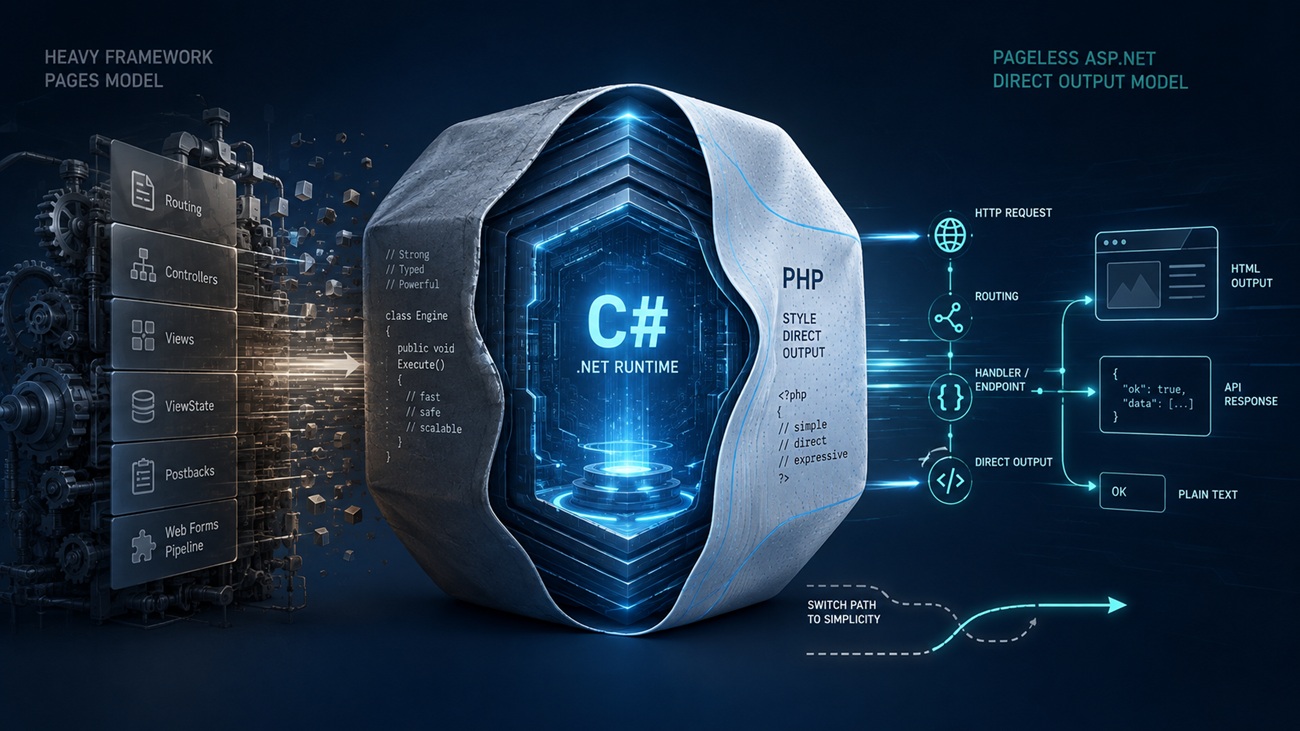
Pageless ASP.NET Web Forms: C# Wearing PHP’s Clothes
How a Direct Request-to-Response Architecture Recovers the Simplicity That Modern C# Web Development Often Hides
Link: Pageless ASP.NET Web Forms Code Reference.
For more than twenty years, C# web development has moved through a succession of programming models.
ASP.NET Web Forms attempted to make web development resemble Windows desktop programming. MVC restored the language of HTTP and introduced controllers and views. Razor Pages reorganized that model around pages. ASP.NET Core rebuilt the runtime around portability, dependency injection, middleware, and high-performance hosting. Minimal APIs later returned to a smaller and more direct endpoint model. Blazor introduced yet another way to think about web application development.
Each generation solved real problems.
But every generation also added a new vocabulary, a new set of abstractions, and a new definition of what a C# web application should look like.
Pageless ASP.NET begins with a different question:
What is the smallest useful web architecture that can be built inside the classic ASP.NET and IIS environment while retaining the advantages of C#?
Its answer is surprisingly simple:
Receive a URL, execute an obvious C# handler, generate HTML or JSON, write it to the response, and finish the request.
That programming model feels remarkably similar to native PHP.
This is why Pageless ASP.NET can be described as C# wearing PHP’s clothes.
It uses the C# language, the .NET runtime, IIS, compiled assemblies, strong typing, and Visual Studio. But at the application level, it adopts the directness traditionally associated with PHP: one request enters, one visible piece of code handles it, and output is written directly to the browser.
This is not an attempt to turn C# into PHP.
It is an attempt to recover a form of web development simplicity that C# frameworks have often hidden beneath increasingly sophisticated machinery.
1. Pageless Is Not Really Web Forms
Pageless ASP.NET runs inside the classic ASP.NET hosting environment, but it deliberately abandons almost everything developers normally associate with Web Forms.
There are:
- no
.aspxmarkup files, - no master pages,
- no server controls,
- no ViewState,
- no postbacks,
- no
Page_Load, - no control tree,
- and no page lifecycle.
Instead, every request is intercepted near the beginning of the ASP.NET pipeline through Application_BeginRequest in Global.asax.cs.
A central route table examines the request path and dispatches it to a plain C# handler:
protected void Application_BeginRequest(object sender, EventArgs e)
{
    string path = Request.Path.ToLower().Trim().TrimEnd('/');

    switch (path)
    {
        case "":
        case "/home":
            HomePage.HandleRequest();
            return;

        case "/books":
            BookPage.HandleRequest();
            return;

        case "/bookapi":
            BookPageApi.HandleRequest();
            return;

        default:
            return;
    }
}
There is no physical /books.aspx page.
There is only a route and the C# method responsible for it.
The page handler creates the complete HTML document:
public static void HandleRequest()
{
    HttpResponse response = HttpContext.Current.Response;
    StringBuilder html = new StringBuilder();

    PageTemplate template = new PageTemplate
    {
        Title = "Book Catalog"
    };

    // Writes <!DOCTYPE html>, <head>, navigation,
    // and opens the main content container.
    html.Append(template.GenerateHtmlHeader());

    // Page-specific HTML.
    html.Append("<h1>Book Inventory</h1>");
    html.Append("<div id='bookList'>Loading books...</div>");

    // Writes the footer, scripts, and closing HTML tags.
    html.Append(template.GenerateHtmlFooter());

    response.ContentType = "text/html; charset=utf-8";
    response.Write(html.ToString());

    // Finish the response without Response.End()
    // or its ThreadAbortException behavior.
    ApiHelper.EndResponse();
}
The three important calls can be read as a simple document composition model:
GenerateHtmlHeader()
    → <!DOCTYPE html>
    → <html>
    → <head>...</head>
    → navigation
    → <main>

Page-specific handler output
    → <h1>...</h1>
    → feature content

GenerateHtmlFooter()
    → </main>
    → footer
    → scripts
    → </body>
    → </html>
The underlying template does not need to be mysterious. In its smallest useful form, it is simply a C# class that emits the shared beginning and ending of the document:
public class PageTemplate
{
    public string Title = "My Website";

    public string GenerateHtmlHeader()
    {
        return $@"<!DOCTYPE html>
<html>
<head>
    <meta charset='utf-8'>
    <title>{HttpUtility.HtmlEncode(Title)}</title>
</head>
<body>
    <main>";
    }

    public string GenerateHtmlFooter()
    {
        return @"
    </main>
</body>
</html>";
    }
}
A production template can add navigation, stylesheets, scripts, metadata, session-aware links, and other shared elements. Architecturally, however, it remains this simple: generate the common shell, insert the page-specific body, and close the document.
This is technically hosted by ASP.NET, but it is no longer using the Web Forms programming model.
Classic ASP.NET has become the hosting substrate rather than the architecture.
That distinction is central to understanding Pageless.
2. Why It Feels Like PHP
A traditional PHP application often makes the relationship between a URL and its implementation obvious.
A request reaches a script. The script reads parameters, queries data, includes shared layout fragments, prints HTML or JSON, and ends.
Pageless ASP.NET follows almost exactly the same mental model.
| Pageless C# | Conceptual PHP equivalent |
|---|---|
Route entry in Global.asax.cs | URL mapped to a PHP script |
PageTemplate | Header and footer includes |
StringBuilder.Append() | Building or echoing HTML |
Response.Write() | Writing to the output stream |
ApiHelper.EndResponse() | exit() after output |
| Page handler | Page script |
| API handler | JSON or AJAX endpoint |
| Custom application session | Application-managed session state |
The equivalence is not exact at the runtime level. PHP and ASP.NET have different execution, memory, hosting, and deployment models.
But from the developer’s perspective, the flow is similar:
Request
  → obvious handler
  → application logic
  → HTML or JSON
  → response
The similarity extends to the end of the endpoint:
<?php
$html = "<h1>Book Catalog</h1>";
echo $html;
exit;
string html = "<h1>Book Catalog</h1>";
Response.Write(html);
ApiHelper.EndResponse();ApiHelper.EndResponse() plays approximately the same architectural role as PHP’s exit(): the endpoint has finished producing its response and hands control back to the host.
Internally, however, the two are not identical. PHP’s exit() terminates the current script. The C# helper performs ASP.NET-specific response and pipeline cleanup—typically flushing output, suppressing further response content, and calling CompleteRequest()—rather than terminating a PHP execution context.
That directness is the meaning of “PHP’s clothes.”
Pageless does not borrow PHP’s language design. It borrows PHP’s request-oriented simplicity.
3. What C# Brings to the PHP-Like Model
The PHP comparison explains the shape of the architecture, but Pageless still retains several advantages associated with C#.
Strong typing
Models, database values, request structures, and application services can use compile-time types rather than relying entirely on dynamically shaped values.
Compiler support
Renaming a property, changing a method signature, or restructuring a class can reveal dependent code at compile time.
IDE navigation and refactoring
Handlers, templates, session objects, data access code, and helper methods remain navigable through the C# tooling ecosystem.
Shared in-process state
Because handlers operate inside one application process, they can access shared application memory directly when the deployment model permits it.
Existing .NET libraries
The architecture can use the broader .NET ecosystem without requiring a second language or runtime.
Pageless therefore offers a particular combination:
PHP-like request handling with C# language semantics and .NET tooling.
That combination is the architecture’s real identity.
4. The Two-Handler Pattern
Each feature commonly has two endpoints.
The first returns a complete HTML document:
/booksThe second handles data operations initiated by JavaScript:
/bookapiThe page handler renders the initial document. The API handler processes actions such as:
- loading records,
- saving records,
- deleting records,
- validating input,
- returning HTML fragments,
- or returning JSON.
The browser uses ordinary HTML elements and native JavaScript fetch() calls rather than server controls and postbacks.
This creates a small and understandable feature boundary:
BookPage.cs
BookPageApi.cs
books.js
books.css
The pattern is not revolutionary. In fact, that is part of its value.
It resembles the way many web applications were built before frameworks attempted to make HTTP appear stateful, component-based, or invisible.
Pageless simply applies that old directness within C#.
5. The Real Problem It Solves
Pageless should not be presented as a replacement for every C# web framework.
Its strongest use case is narrower and more practical.
Many organizations still operate large ASP.NET Web Forms systems. These applications may contain years of business logic, database integration, authentication rules, reporting code, and operational knowledge.
A complete rewrite into ASP.NET Core may require:
- replacing the hosting model,
- rewriting authentication,
- redesigning routing,
- rebuilding frontend behavior,
- retraining developers,
- migrating deployment infrastructure,
- and reproducing years of undocumented behavior.
The risk is not merely technical. A rewrite can remove visible defects while accidentally removing invisible business rules.
Pageless offers another path.
A team can retain the existing IIS application and gradually route selected URLs into new handlers.
Old .aspx pages can continue operating while new Pageless features are introduced beside them.
This enables modernization at the level of a route or feature rather than at the level of the entire application.
That makes Pageless particularly valuable as a legacy modernization pattern.
It does not demand that an organization abandon its existing system before gaining the benefits of simpler request handling.
6. Removing Hidden Machinery
Traditional Web Forms performs substantial work to support its programming model.
It reconstructs server controls, restores state, processes postback data, invokes lifecycle events, and serializes state back into the page.
This machinery is useful when the developer wants the Web Forms model.
It becomes unnecessary overhead when the application has already moved toward:
- plain HTML,
- JavaScript-driven interaction,
- API calls,
- and explicit state management.
A GridView makes the contrast visible.
What the Web Forms source shows
A server-side grid can appear concise and declarative:
<asp:GridView
    ID="gvBooks"
    runat="server"
    AutoGenerateColumns="False"
    DataKeyNames="Id"
    OnRowCommand="gvBooks_RowCommand">
    <Columns>
        <asp:BoundField DataField="Title" HeaderText="Title" />
        <asp:BoundField DataField="Author" HeaderText="Author" />
        <asp:ButtonField
            CommandName="EditBook"
            Text="Edit" />
    </Columns>
</asp:GridView>
That convenience is real. The control can provide data binding, command handling, paging, sorting, templates, and integration with the page lifecycle.
But a GridView is not merely an HTML table generator. It is a stateful server-side component participating in the Web Forms control tree.
Conceptually, the runtime must perform work resembling:
Parse .aspx markup
→ instantiate GridView and child controls
→ restore control state and ViewState
→ load postback values
→ execute lifecycle events
→ perform data binding
→ translate server controls into HTML
→ serialize state for the next request
What Pageless writes instead
Pageless makes a different choice: render the table that the browser actually needs, and no more.
StringBuilder html = new StringBuilder();

html.Append(@"
<table>
    <thead>
        <tr><th>Title</th><th>Author</th><th></th></tr>
    </thead>
    <tbody>
");

foreach (obBook book in books)
{
    html.Append($@"
        <tr id='trBook_{book.Id}'>
            <td>{HttpUtility.HtmlEncode(book.Title)}</td>
            <td>{HttpUtility.HtmlEncode(book.Author)}</td>
            <td>
                <button type='button' onclick='editBook({book.Id})'>
                    Edit
                </button>
            </td>
        </tr>
    ");
}

html.Append(@"
    </tbody>
</table>
");

string result = html.ToString();
That output can be returned by an API for client-side insertion:
Response.ContentType = "text/html; charset=utf-8";
Response.Write(result);
ApiHelper.EndResponse();
Or the same generated table can be composed into a traditional dynamic page during an incremental migration:
LiteralControlTable.Text = result;The execution path is now close to what appears in the source:
Loop through books
→ encode values
→ append rows
→ write HTML
This does not prove that GridView is always wrong or that manual rendering is always superior.
The two models optimize for different things.
| GridView model | Pageless rendering |
|---|---|
| Declarative server component | Explicit HTML generation |
| Automatic data binding | Direct loop over data |
| Server-side command events | JavaScript plus explicit API action |
| ViewState and control state | Re-fetching or client-managed state |
| Built-in behaviors | Only the behavior the feature requires |
| Framework-managed lifecycle | Visible request-to-output flow |
| Less rendering code | Less hidden runtime machinery |
Pageless does not optimize the GridView.
It removes the need for a
GridViewto exist.
There is no ViewState because there are no server controls requiring ViewState.
There is no postback because browser actions call explicit endpoints.
There is no page lifecycle because the handler already knows what it needs to do.
There is no master page because a plain C# template can generate the shared document shell.
The result is not “zero allocation” or “zero overhead.” The application still creates strings, objects, database commands, JSON, buffers, and other managed data.
The more accurate claim is:
Pageless removes entire categories of framework work that are unnecessary for direct HTML and API-based applications.
This can reduce latency, memory allocation, and conceptual complexity—especially in applications that previously relied heavily on server controls and ViewState.
7. Concurrency Without ASP.NET Session Serialization
Classic ASP.NET session state can serialize concurrent requests from the same user when writable session state is acquired.
This behavior protects session data from certain races, but it can also create avoidable latency.
A browser may issue several simultaneous API calls while the server processes them one after another because they belong to the same session.
Pageless disables the built-in ASP.NET session module and uses an application-managed session store.
A session identifier stored in a cookie maps to an in-memory state object, commonly held in a ConcurrentDictionary.
This allows independent requests from the same user to proceed concurrently.
However, the benefit should be described carefully.
ConcurrentDictionary provides thread-safe access to the dictionary itself. It does not make every multi-step business operation atomic.
For example, two simultaneous requests can still conflict when both attempt to:
- update the same shopping cart,
- modify the same account record,
- consume a one-time token,
- or start the same task.
Pageless removes broad framework-controlled serialization.
In exchange, developers must introduce synchronization where the business domain genuinely requires it.
This is not a defect. It is a transfer of responsibility:
Instead of locking every session request automatically, the application controls concurrency at the resource or operation that actually needs protection.
For performance-sensitive systems, that can be a much better trade.
8. The Cost of Explicitness
Pageless gains simplicity by making behavior visible.
But visible code is still code that must be written correctly.
Encoding must be deliberate
When HTML is assembled manually, all untrusted values must be encoded for the correct context.
HTML text, HTML attributes, URLs, JavaScript strings, and JSON are not interchangeable contexts.
Direct rendering gives the developer control, but it also removes some safeguards provided by templating systems.
Routing must remain organized
A single switch statement is exceptionally clear in a small or medium application.
As the number of routes grows, the route table may need to be separated by module, prefix, or feature.
Explicit routing should remain explicit without becoming one enormous file.
In-memory state defines the deployment model
An in-process session dictionary is fast and simple on one application instance.
It is not automatically shared across:
- multiple IIS worker processes,
- multiple servers,
- container replicas,
- or independently deployed application nodes.
Applications that require horizontal distribution may need sticky sessions, a shared backing store, or a different state architecture.
Process memory is not durable infrastructure
Background work, task status, and temporary state held in the application process can be lost during deployment, app-pool recycling, machine restart, or failure.
Pageless is strongest when its operational assumptions are understood rather than hidden.
9. How It Compares with ASP.NET Core
Pageless should not be defended by pretending ASP.NET Core is incapable of simplicity.
ASP.NET Core Minimal APIs can also define small and direct endpoints. Developers are not forced to create repository interfaces, DTOs, and multiple abstraction layers for every feature.
The real distinction is philosophical.
ASP.NET Core provides a modern, cross-platform, composable web platform designed to support many application styles and deployment environments.
Pageless is a deliberately narrow architecture optimized for:
- explicitness,
- low ceremony,
- IIS-hosted applications,
- direct HTML and JSON output,
- small teams,
- and incremental modernization of classic systems.
ASP.NET Core asks:
What general platform should modern .NET web applications build upon?
Pageless asks:
What is the smallest architecture required for this application, on this host, under these operational constraints?
Neither question invalidates the other.
Pageless becomes compelling when its narrower question is the one a project actually needs answered.
10. Where Pageless Fits
Pageless is a strong candidate for:
- modernizing existing ASP.NET Web Forms applications,
- internal business systems,
- single-host deployments,
- small teams that prefer explicit code,
- CRUD-heavy applications,
- administration panels,
- specialized high-throughput endpoints,
- prototypes that may become long-lived systems,
- and developers who value C# but dislike framework ceremony.
It is less naturally suited to systems that require:
- effortless horizontal scaling,
- large distributed teams with strict architectural boundaries,
- extensive framework conventions,
- portable cloud-native hosting,
- durable distributed background processing,
- or a large ecosystem of middleware and standardized integrations.
These are not failures.
An architecture becomes trustworthy when it states not only what it can do, but also the conditions under which it works best.
11. The Deeper Lesson
The most important idea in Pageless is not StringBuilder.
It is not Global.asax.
It is not even the removal of ViewState.
The deeper lesson is that a web framework’s programming model is optional.
A runtime may offer page lifecycles, component trees, dependency injection, middleware, controllers, filters, binding systems, and templating engines.
A project does not automatically need all of them.
Sometimes the clearest architecture is still:
URL
→ handler
→ logic
→ output
Pageless ASP.NET demonstrates that this direct model can exist inside the C# ecosystem without abandoning compiled code, strong typing, mature tooling, or an existing IIS application.
It is not a return to primitive programming.
It is a reminder that abstraction should be earned by the problem it solves.
Conclusion
Pageless ASP.NET is C# wearing PHP’s clothes because it adopts PHP’s most enduring architectural quality: the visible connection between an incoming request and the code that produces the response.
Underneath those clothes, it remains C#.
It retains the compiler, the type system, the IDE, the libraries, and the runtime. What it removes is the assumption that every C# web application must be expressed through a large framework-defined programming model.
Its value is not that it defeats ASP.NET Core, replaces every Web Forms application, eliminates garbage collection, or guarantees extraordinary benchmark numbers.
Its value is more grounded:
It gives C# developers a direct, comprehensible, high-control web architecture—especially where existing IIS systems, small teams, and incremental modernization make simplicity more valuable than generality.
Pageless is not the final architecture for the entire web.
It is evidence that C# web development can still be simple.